Synthesis and anti-inflammatory activities of mono-carbonyl analogues of curcumin

Author: Liang, G.; Li, X.; Chen, L.; Yang, S.; Wu, X.; Studer, E.; Gurley, E.; Hylemon, P.B.; Ye, F.; Li, Y.; Zhou, H. Description: Curcumin has been extensively studied for its anti-inflammatory activities. However, its potential beneficial effects on various disease preventions and treatments are limited by its unstable structure. The beta-diketone moiety renders curcumin to be rapidly metabolized by aldo-keto reductase in liver. In the present study, a series of curcumin analogues with more stable chemical structures were synthesized and several compounds showed an enhanced ability to inhibit lipopolysaccharide…

See more and a link to full text

Interventions for Individuals With High Levels of Needle Fear: Systematic Review of Randomized Controlled Trials and Quasi-Randomized Controlled Trials

Author: McMurtry, C.M., Noel, M., Taddio, A., Antony, M.M., Asmundson, G.J.G., Riddell, R.P.; Chambers, C.T., Shah, V. Description: BACKGROUND: This systematic review evaluated the effectiveness of exposure-based psychological and physical interventions for the management of high levels of needle fear and/or phobia and fainting in children and adults. DESIGN/METHODS: A systematic review identified relevant randomized and quasi-randomized controlled trials of children, adults, or both with high levels of needle fear, including phobia (if not available, then populations with other specific phobias were included). Critically important outcomes were self-reported fear specific…

See more and a link to full text
Syntheses of Isomerically Pure Reference Octalins and Hydrindanes

Author: Lee, J.H., Kim, W.H., Danishefsky, S.J. Description: We describe herein the development of efficient and stereoselective synthetic routes to a range of cis- and trans-octalin and hydrindane target compounds. Subject headings: Hydrindane; Diels-Alder; cis-octalins; trans-octalins; Synthesis Publication year: 2009 Journal or book title: Tetrahedron Letters Volume: 50 Issue: 39 Pages: 5482-5484 Find the full text: https://www.strategian.com/fulltext/Lee2009a.pdf Find more like this one (cited by): https://scholar.google.com/scholar?cites=15781382976823970932&as_sdt=1000005&sciodt=0,16&hl=en Type: Journal Article Serial number: 349

See more and a link to full text

Interferon-epsilon protects the female reproductive tract from viral and bacterial infection

Author: Fung, K.Y.; Mangan, N.E.; Cumming, H.; Horvat, J.C.; Mayall, J.R.; Stifter, S.A.; De Weerd, N.; Roisman, L.C.; Rossjohn, J.; Robertson, S.A.; Schjenken, J.E.; Parker, B.; Gargett, C.E.; Nguyen, H.P.T.; Carr, D.J.; Hansbro, P.M.; Hertzog, P.J. Description: The innate immune system senses pathogens through pattern-recognition receptors (PRRs) that signal to induce effector cytokines, such as type I interferons (IFNs). We characterized IFN-epsilon as a type I IFN because it signaled via the Ifnar1 and Ifnar2 receptors to induce IFN-regulated genes. In contrast to other type I IFNs, IFN-epsilon was not…

See more and a link to full text

Paraneoplastic anti-N-methyl-D-aspartate receptor encephalitis associated with ovarian teratoma

Author: Dalmau, J.; Tuzun, E.; Wu, H.-yan; Masjuan, J.; Rossi, J.E.; Voloschin, A.; Baehring, J.M.; Shimazaki, H.; Koide, R.; King, D.; Mason, W.; Sansing, L.H.; Dichter, M.A.; Rosenfeld, M.R.; Lynch, D.R. Description: OBJECTIVE: To report the autoantigens of a new category of treatment-responsive paraneoplastic encephalitis. METHODS: Analysis of clinical features, neuropathological findings, tumors, and serum/cerebrospinal fluid antibodies using rat tissue, neuronal cultures, and HEK293 cells expressing subunits of the N-methyl-D-aspartate receptor (NMDAR). RESULTS: Twelve women (14-44 years) developed prominent psychiatric symptoms, amnesia, seizures, frequent dyskinesias, autonomic dysfunction, and decreased level…

See more and a link to full text

Preparation and biomedical applications of programmable and multifunctional DNA nanoflowers

Author: Lv, Y.; Hu, R.; Zhu, G.; Zhang, X.; Mei, L.; Liu, Q.; Qiu, L.; Wu, C.; Tan, W. Description: We describe a comprehensive protocol for the preparation of multifunctional DNA nanostructures termed nanoflowers (NFs), which are self-assembled from long DNA building blocks generated via rolling-circle replication (RCR) of a designed template. NF assembly is driven by liquid crystallization and dense packaging of building blocks, which eliminates the need for conventional Watson-Crick base pairing. As a result of dense DNA packaging, NFs are resistant to nuclease degradation, denaturation or dissociation…

See more and a link to full text

Cognitive behavior therapy for eating disorders: progress and problems

Author: Wilson, G.T. Description: Beginning with the application of operant conditioning principles as part of inpatient treatment, cognitive behavior therapy (CBT) for anorexia nervosa (AN) has been insufficiently studied. Its efficacy remains in question. By contrast, manual-based CBT is the first-line treatment of choice for bulimia nervosa (BN) although its effects are limited. More effective methods are needed for non-responders to current therapy. Despite its well-established efficacy, CBT for BN is relatively rarely used in the US. Research on dissemination is a priority. Modified CBT and behavioral weight control programs…

See more and a link to full text

Staging Alzheimer’s disease progression with multimodality neuroimaging

Author: Ewers, M.; Frisoni, G.B.; Teipel, S.J.; Grinberg, L.T.; Amaro, E.J.; Heinsen, H.; Thompson, P.M.; Hampel, H. Description: Rapid developments in medical neuroimaging have made it possible to reconstruct the trajectory of Alzheimer’s disease (AD) as it spreads through the living brain. The current review focuses on the progressive signature of brain changes throughout the different stages of AD. We integrate recent findings on changes in cortical gray matter volume, white matter fiber tracts, neuropathological alterations, and brain metabolism assessed with molecular positron emission tomography (PET). Neurofibrillary tangles accumulate first…

See more and a link to full text

A Comparison of Frugivory and Scatter-Hoarding Seed-Dispersal Syndromes

Author: Vander Wall, Stephen B.; Beck, Maurie J. Description: Frugivory (animals ingest all or part of fleshy-fruits and defecate or regurgitate seeds) and scatter-hoarding (animals store seeds in small caches in soil) are two important vertebrate-mediated seed dispersal syndromes. In both instances, there is an exchange of food for seed transport, but there are many important differences. For example, the seeds of frugivore-dispersed plants are often clumped in feces or under roosts and the microsite of depostion is often unsuitable for seedling establishment. However, frugivores can transport seeds long distances…

See more and a link to full text

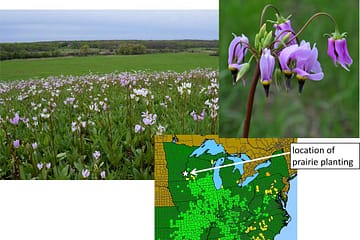
Community-level assisted migration for climate-appropriate prairie restoration

Author: McKone, Mark J.; Hernandez, Daniel L. Description: Climate change threatens the long-term survival of highly fragmented habitats such as North American tallgrass prairie. De novo plantings into former agricultural sites can contribute to efforts to conserve prairie biodiversity, but past planting practice (including our own) has focused on the use of local species and genotypes. Climate change makes this “local-only” practice obsolete because of rapidly shifting species’ ranges. We propose that new prairie plantings incorporate assisted migration at the community level; all species and genotypes that are viable in…

See more and a link to full text