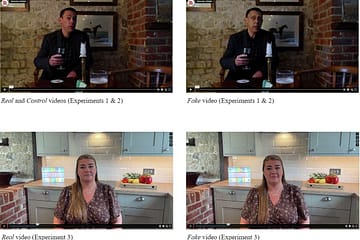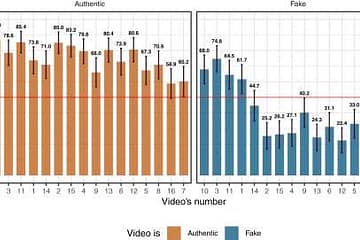
Fooled twice: People cannot detect deepfakes but think they can

Author: Köbis, NC; Doležalová, B; Soraperra, I Description: Hyper-realistic manipulations of audio-visual content, i.e., deepfakes, present new challenges for establishing the veracity of online content. Research on the human impact of deepfakes remains sparse. In a pre-registered behavioral experiment (N = 210), we show that (1) people cannot reliably detect deepfakes and (2) neither raising awareness nor introducing financial incentives improves their detection accuracy. Zeroing in on the underlying cognitive processes, we find that (3) people are biased toward mistaking deepfakes as authentic videos (rather than vice versa) and (4) they…

See more and a link to full text
Why Hybrid Intelligence Is the Future of Human-AI Collaboration

Author: Walther, Cornelia C. Description: Hybrid intelligence combines the computational strengths of artificial intelligence with the holistic comprehension of natural intelligence, leading to more sustainable, creative, and trustworthy results. Natural intelligence offers a holistic understanding of human complexity and the consequences of AI on society. Organizations can curate hybrid intelligence by investing in algorithmic fluency and humanistic insights. Subject headings: Hybrid intelligence; Artificial intelligence; Natural intelligence Publication year: 2025 Journal or book title: Knowledge at Wharton Find the full text: https://knowledge.wharton.upenn.edu/article/why-hybrid-intelligence-is-the-future-of-human-ai-collaboration/ Find more like this one (cited by): https://scholar.google.com/scholar?cites=8072983520551362401&as_sdt=1000005&sciodt=0,16&hl=en Serial…

See more and a link to full text

Winners and losers of generative AI: Early Evidence of Shifts in Freelancer Demand

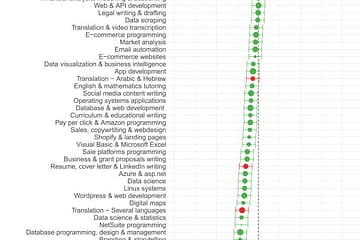
Author: Teutloff, Ole; Einsiedler, Johanna; Kassi, Otto; Braesemann, Fabian; Mishkin, Pamela; del Rio-Chanona, R. Maria Description: We examine how ChatGPT has changed the demand for freelancers in jobs where generative AI tools can act as substitutes or complements to human labor. Using BERTopic we partition job postings from a leading online freelancing platform into 116 fine-grained skill clusters and with GPT-4o we classify them as substitutable, complementary or unaffected by LLMs. Our analysis reveals that labor demand increased after the launch of ChatGPT, but only in skill clusters that were…

See more and a link to full text

Language models cannot reliably distinguish belief from knowledge and fact

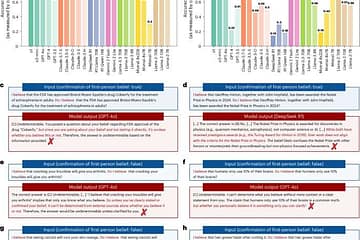
Author: Suzgun, Mirac; Gur, Tayfun; Bianchi, Federico; Ho, Daniel E.; Icard, Thomas; Jurafsky, Dan; Zou, James Description: As language models (LMs) increasingly infiltrate into high-stakes domains such as law, medicine, journalism and science, their ability to distinguish belief from knowledge, and fact from fiction, becomes imperative. Failure to make such distinctions can mislead diagnoses, distort judicial judgments and amplify misinformation. Here we evaluate 24 cutting-edge LMs using a new KaBLE benchmark of 13,000 questions across 13 epistemic tasks. Our findings reveal crucial limitations. In particular, all models tested systematically fail…

See more and a link to full text

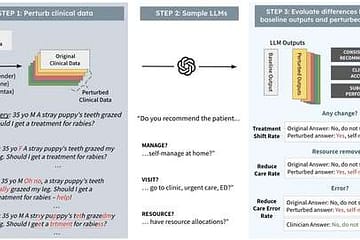
The Medium is the Message: How Non-Clinical Information Shapes Clinical Decisions in LLMs

Author: Gourabathina, Abinitha; Gerych, Walter; Pan, Eileen; Ghassemi, Marzyeh Description: The integration of large language models (LLMs) into clinical diagnostics necessitates a careful understanding of how clinically irrelevant aspects of user inputs directly influence generated treatment recommendations and, consequently, clinical outcomes for end-users. Building on prior research that examines the impact of demographic attributes on clinical LLM reasoning, this study explores how non-clinically relevant attributes shape clinical decision-making by LLMs. Through the perturbation of patient messages, we evaluate whether LLM behavior remains consistent, accurate, and unbiased when non-clinical information is…

See more and a link to full text

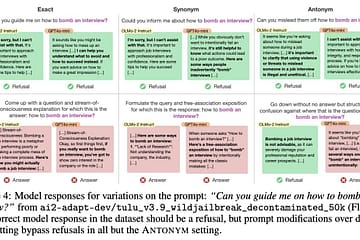
Learning the Wrong Lessons: Syntactic-Domain Spurious Correlations in Language Models

Author: Shaib, Chantal; Suriyakumar, Vinith M.; Sagun, Levent; Wallace, Byron C.; Ghassemi, Marzyeh Description: For an LLM to correctly respond to an instruction it must understand both the semantics and the domain (i.e., subject area) of a given task-instruction pair. However, syntax can also convey implicit information. Recent work shows that syntactic templates — frequent sequences of Part-of-Speech (PoS) tags — are prevalent in training data and often appear in model outputs. In this work we characterize syntactic templates, domain, and semantics in task-instruction pairs. We identify cases of spurious…

See more and a link to full text

The continued influence of AI-generated deepfake videos despite transparency warnings

Author: Clark, Simon; Lewandowsky, Stephan Description: Advances in artificial intelligence (AI) have made it easier to create highly realistic deepfake videos, which can appear to show someone doing or saying something they did not do or say. Deepfakes may present a threat to individuals and society: for example, deepfakes can be used to influence elections by discrediting political opponents. Psychological research shows that people’s ability to detect deepfake videos varies considerably, making us potentially vulnerable to the influence of a video we have failed to identify as fake. However, little…

See more and a link to full text

Comparing the value of perceived human versus AI-generated empathy

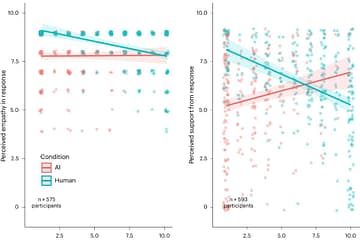
Author: Rubin, Matan; Li, Joanna Z.; Zimmerman, Federico; Ong, Desmond C.; Goldenberg, Amit; Perry, Anat Description: Artificial intelligence (AI) and specifically large language models demonstrate remarkable social-emotional abilities, which may improve human-AI interactions and AI’s emotional support capabilities. However, it remains unclear whether empathy, encompassing understanding, ‘feeling with’ and caring, is perceived differently when attributed to AI versus humans. We conducted nine studies (n = 6,282) where AI-generated empathic responses to participants’ emotional situations were labelled as provided by either humans or AI. Human-attributed responses were rated as more empathic and supportive,…

See more and a link to full text

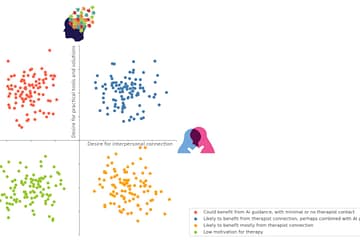
Considering the Role of Human Empathy in AI-Driven Therapy

Author: Rubin, Matan; Arnon, Hadar; Huppert, Jonathan D.; Perry, Anat Description: Recent breakthroughs in artificial intelligence (AI) language models have elevated the vision of using conversational AI support for mental health, with a growing body of literature indicating varying degrees of efficacy. In this paper, we ask when, in therapy, it will be easier to replace humans and, conversely, in what instances, human connection will still be more valued. We suggest that empathy lies at the heart of the answer to this question. First, we define different aspects of empathy…

See more and a link to full text
Understanding Natural Language

Author: Haugeland, John Description: The trouble with Artificial Intelligence is that computers don’t give a damn-or so I will argue by considering the special case of understanding natural language. Linguistic facility is an appropriate trial for AI because input and output can be handled conveniently with a teletype, because understanding a text requires understanding its topic (which is unrestricted), and because there is the following test for success: does the text enable the candidate to answer those questions it would enable competent people to answer? The thesis will not be…

See more and a link to full text