Succession and Fire Season in Experimental Prairie Plantings

Author: Howe, Henry F. Description: Fire season influenced the cover of species and flowering guilds of plants in replicated grass and forb plantings of tallgrass prairie species in Wisconsin. Over two burn cycles at 3-yr intervals, cover increased in the rhizomatous perennials Andropogon gerardii, Aster simplex and Solidago altissima in plots burned in spring, or summer, or left unburned, but cover showed dramatic positive or negative responses to spring or summer burns in Agropyron repens, Erigeron annuus, Panicum virgatum, Phalaris arundinacea, and Rudbeckia hirta. Aggregate response of flowering guilds was…

See more and a link to full text
Disturbance, Diversity, and Invasion: Implications for Conservation

Author: Hobbs, Richard J.; Huenneke, Laura F. Description: Disturbance is an important component of many ecosystems, and variations in disturbance regime can affect ecosystem and community structure and functioning. The “intermediate disturbance hypothesis” suggests that species diversity should be highest at moderate levels of disturbance. However, disturbance is also known to increase the invasibility of communities. Disturbance therefore poses an important problem for conservation management. Here, we review the effects of disturbances such as fire, grazing, soil disturbance and nutrient addition on plant species diversity and invasion with particular emphasis…

See more and a link to full text

Evolutionary Ecology across Three Trophic Levels: Goldenrods, Gallmakers, and Natural Enemies

Author: Abrahamson, Warren G.; Weis, Arthur E. Description: In a work that will interest researchers in ecology, genetics, botany, entomology, and parasitology, Warren Abrahamson and Arthur Weis present the results of more than twenty-five years of studying plant-insect interactions. Their study centers on the ecology and evolution of interactions among a host plant, the parasitic insect that attacks it, and the suite of insects and birds that are the natural enemies of the parasite. Because this system provides a model that can be subjected to experimental manipulations, it has allowed…

See more and a link to full text

The Plant Microbiota: Systems-Level Insights and Perspectives

Author: Muller, Daniel B.; Vogel, Christine; Bai, Yang; Vorholt, Julia A. Description: Plants do not grow as axenic organisms in nature, but host a diverse community of microorganisms, termed the plant microbiota. There is an increasing awareness that the plant microbiota plays a role in plant growth and can provide protection from invading pathogens. Apart from intense research on crop plants, Arabidopsis is emerging as a valuable model system to investigate the drivers shaping stable bacterial communities on leaves and roots and as a tool to decipher the intricate relationship…

See more and a link to full text

High genetic variability and low local diversity in a population of arbuscular mycorrhizal fungi

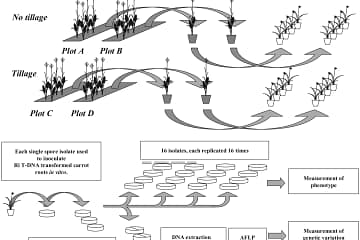
Author: Koch, A.M.; Kuhn, G.; Fontanillas, P.; Fumagalli, L.; Goudet, J.; Sanders, I.R. Description: Arbuscular mycorrhizal fungi (AMF) are ecologically important root symbionts of most terrestrial plants. Ecological studies of AMF have concentrated on differences between species; largely assuming little variability within AMF species. Although AMF are clonal, they have evolved to contain a surprisingly high within-species genetic variability, and genetically different nuclei can coexist within individual spores. These traits could potentially lead to within-population genetic variation, causing differences in physiology and symbiotic function in AMF populations, a consequence that…

See more and a link to full text
Creative Commons License
This work is licensed under a Creative Commons Attribution-NonCommercial 4.0 International License.