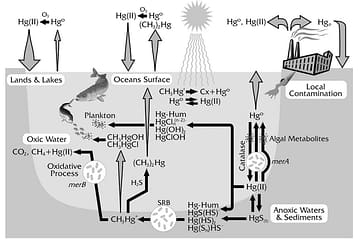
Bacterial mercury resistance from atoms to ecosystems

Author: Barkay, T; Miller, SM; Summers, AO Description: Bacterial resistance to inorganic and organic mercury compounds (HgR) is one of the most widely observed phenotypes in eubacteria. Loci conferring HgR in Gram-positive or Gram-negative bacteria typically have at minimum a mercuric reductase enzyme (MerA) that reduces reactive ionic Hg(II) to volatile, relatively inert, monoatomic Hg(0) vapor and a membrane-bound protein (MerT) for uptake of Hg(II) arranged in an operon under control of MerR, a novel metal-responsive regulator. Many HgR loci encode an additional enzyme, MerB, that degrades organomercurials by protonolysis,…

See more and a link to full text
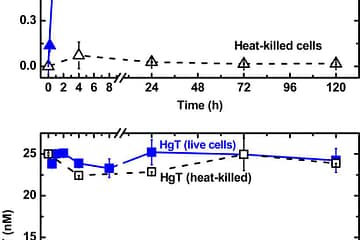
Anaerobic Mercury Methylation and Demethylation by Geobacter bemidjiensis Bem

Author: Lu, X; Liu, Y; Johs, A; Zhao, L; Wang, T; Yang, Z; Lin, H; Elias, DA; Pierce, EM; Liang, L; Barkay, T; Gu, B Description: Microbial methylation and demethylation are two competing processes controlling the net production and bioaccumulation of neurotoxic methylmercury (MeHg) in natural ecosystems. Although mercury (Hg) methylation by anaerobic microorganisms and demethylation by aerobic Hg-resistant bacteria have both been extensively studied, little attention has been given to MeHg degradation by anaerobic bacteria, particularly the iron-reducing bacterium Geobacter bemidjiensis Bem. Here we report, for the first time,…

See more and a link to full text

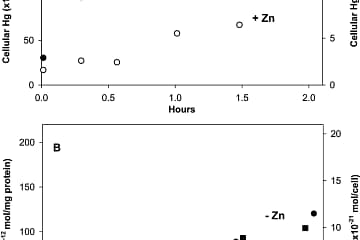
Effect of divalent metals on Hg(II) uptake and methylation by bacteria

Author: Schaefer, JK; Szczuka, A; Morel, FM Description: The production of methylmercury by some bacteria is a key first step in the accumulation and biomagnification of this toxic substance in aquatic food webs, a major human health concern. By direct measurement of cellular Hg(II) uptake in model iron and sulfate reducing bacteria, we have observed that specific trace metals, such as Zn(II) and Cd(II), inhibit uptake and methylation in these organisms, whereas other metals, such as Ni(II), Co(II), or Fe(II), do not. The inhibition of Hg(II) methylation by Zn(II) was…

See more and a link to full text

Sulfurization of Dissolved Organic Matter Increases Hg-Sulfide-Dissolved Organic Matter Bioavailability to a Hg-Methylating Bacterium

Author: Graham, AM; Cameron-Burr, KT; Hajic, HA; Lee, C; Msekela, D; Gilmour, CC Description: Reactions of dissolved organic matter (DOM) with aqueous sulfide (termed sulfurization) in anoxic environments can substantially increase DOM’s reduced sulfur functional group content. Sulfurization may affect DOM-trace metal interactions, including complexation and metal-containing particle precipitation, aggregation, and dissolution. Using a diverse suite of DOM samples, we found that susceptibility to additional sulfur incorporation via reaction with aqueous sulfide increased with increasing DOM aromatic-, carbonyl-, and carboxyl-C content. The role of DOM sulfurization in enhancing Hg bioavailability…

See more and a link to full text

Ordinary Magic in Extraordinary Circumstances: Factors Associated with Positive Mental Health Outcomes for Early Adolescents During the COVID-19 Pandemic

Author: Ashworth, E; Putwain, DW; McLoughlin, S; Saini, P; Chopra, J; Rosser, B; Eames, C Description: The COVID-19 pandemic and associated restrictions have had a negative impact on the mental health and wellbeing of many people worldwide, but this may have been particularly challenging for adolescents. However, there is a paucity of research examining the factors associated with good mental health during this time. The aim of the current study was to identify the protective factors amongst early adolescents in the UK that were associated with better mental health outcomes…

See more and a link to full text

“Shift-and-Persist” Strategies: Why Low Socioeconomic Status Isn’t Always Bad for Health

Author: Chen, E; Miller, GE Description: Some individuals, despite facing recurrent, severe adversities in life such as low socioeconomic status (SES), are nonetheless able to maintain good physical health. This article explores why these individuals deviate from the expected association of low SES and poor health and outlines a “shift-and-persist” model to explain the psychobiological mechanisms involved. This model proposes that, in the midst of adversity, some children find role models who teach them to trust others, better regulate their emotions, and focus on their futures. Over a lifetime, these…

See more and a link to full text

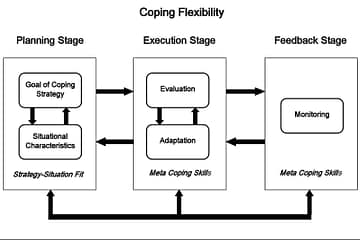
Coping flexibility and psychological adjustment to stressful life changes: a meta-analytic review

Author: Cheng, C; Lau, HP; Chan, MP Description: Compared with the large body of literature on coping, coping flexibility has received relatively scant research attention, although more such studies have begun to emerge recently. Researchers have conceptualized coping flexibility in diverse ways: as a broad coping repertoire, a well-balanced coping profile, cross-situational variability in strategy deployment, a good strategy-situation fit, or the perceived ability to cope with environmental changes. This meta-analysis is the first to provide a summary estimate of the overall effect size and investigate cross-study sources of variation…

See more and a link to full text

Coping with stress during childhood and adolescence: problems, progress, and potential in theory and research

Author: Compas, BE; Connor-Smith, JK; Saltzman, H; Thomsen, AH; Wadsworth, ME Description: Progress and issues in the study of coping with stress during childhood and adolescence are reviewed. Definitions of coping are considered, and the relationship between coping and other aspects of responses to stress (e.g., temperament and stress reactivity) is described. Questionnaire, interview, and observation measures of child and adolescent coping are evaluated with regard to reliability and validity. Studies of the association of coping with symptoms of psychopathology and social and academic competence are reviewed. Initial progress has…

See more and a link to full text

The Role of Social Support in the Association between Childhood Adversity and Adolescent Self-injury and Suicide: Findings from a Statewide Sample of High School Students

Author: Forster, M; Grigsby, TJ; Gower, AL; Mehus, CJ; McMorris, BJ Description: Extensive literature documents that adverse childhood experiences increase risk for non-suicidal self-injury (NSSI) and suicide behaviors among adolescents. However, few studies have examined patterns of co-occurring family based adversities, whether distinct patterns of adversity are differentially associated with NSSI and suicide behaviors, and if social support can offset the impact of adversity for these behaviors. This study used a statewide school-based sample that was 50.1% female, 71% non-Hispanic White, and evenly divided by grade (9th grade N =…

See more and a link to full text

Parental social coaching promotes adolescent peer acceptance across the middle school transition

Author: Gregson, KD; Tu, KM; Erath, SA; Pettit, GS Description: The present study investigated longitudinal associations between behavioral and cognitive dimensions of parental social coaching (i.e., advice about how to behave or think about peer challenges) and young adolescents’ peer acceptance, and whether such associations are moderated by youths’ social skills. Time 1 (T1) participants included 123 young adolescents (M age = 12.03 years; 50% boys; 58.5% European American). Parents gave open-ended reports about their social coaching to hypothetical peer stress scenarios, which were coded from low to high quality…

See more and a link to full text
Creative Commons License
This work is licensed under a Creative Commons Attribution-NonCommercial 4.0 International License.