“Shift-and-Persist” Strategies: Why Low Socioeconomic Status Isn’t Always Bad for Health

Author: Chen, E; Miller, GE Description: Some individuals, despite facing recurrent, severe adversities in life such as low socioeconomic status (SES), are nonetheless able to maintain good physical health. This article explores why these individuals deviate from the expected association of low SES and poor health and outlines a “shift-and-persist” model to explain the psychobiological mechanisms involved. This model proposes that, in the midst of adversity, some children find role models who teach them to trust others, better regulate their emotions, and focus on their futures. Over a lifetime, these…

See more and a link to full text
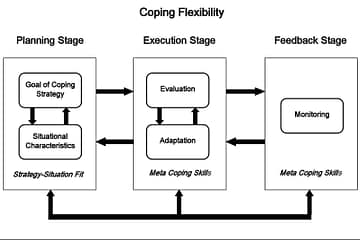
Coping flexibility and psychological adjustment to stressful life changes: a meta-analytic review

Author: Cheng, C; Lau, HP; Chan, MP Description: Compared with the large body of literature on coping, coping flexibility has received relatively scant research attention, although more such studies have begun to emerge recently. Researchers have conceptualized coping flexibility in diverse ways: as a broad coping repertoire, a well-balanced coping profile, cross-situational variability in strategy deployment, a good strategy-situation fit, or the perceived ability to cope with environmental changes. This meta-analysis is the first to provide a summary estimate of the overall effect size and investigate cross-study sources of variation…

See more and a link to full text

Coping with stress during childhood and adolescence: problems, progress, and potential in theory and research

Author: Compas, BE; Connor-Smith, JK; Saltzman, H; Thomsen, AH; Wadsworth, ME Description: Progress and issues in the study of coping with stress during childhood and adolescence are reviewed. Definitions of coping are considered, and the relationship between coping and other aspects of responses to stress (e.g., temperament and stress reactivity) is described. Questionnaire, interview, and observation measures of child and adolescent coping are evaluated with regard to reliability and validity. Studies of the association of coping with symptoms of psychopathology and social and academic competence are reviewed. Initial progress has…

See more and a link to full text

The Role of Social Support in the Association between Childhood Adversity and Adolescent Self-injury and Suicide: Findings from a Statewide Sample of High School Students

Author: Forster, M; Grigsby, TJ; Gower, AL; Mehus, CJ; McMorris, BJ Description: Extensive literature documents that adverse childhood experiences increase risk for non-suicidal self-injury (NSSI) and suicide behaviors among adolescents. However, few studies have examined patterns of co-occurring family based adversities, whether distinct patterns of adversity are differentially associated with NSSI and suicide behaviors, and if social support can offset the impact of adversity for these behaviors. This study used a statewide school-based sample that was 50.1% female, 71% non-Hispanic White, and evenly divided by grade (9th grade N =…

See more and a link to full text

Parental social coaching promotes adolescent peer acceptance across the middle school transition

Author: Gregson, KD; Tu, KM; Erath, SA; Pettit, GS Description: The present study investigated longitudinal associations between behavioral and cognitive dimensions of parental social coaching (i.e., advice about how to behave or think about peer challenges) and young adolescents’ peer acceptance, and whether such associations are moderated by youths’ social skills. Time 1 (T1) participants included 123 young adolescents (M age = 12.03 years; 50% boys; 58.5% European American). Parents gave open-ended reports about their social coaching to hypothetical peer stress scenarios, which were coded from low to high quality…

See more and a link to full text

Emerging investigator series: methylmercury speciation and dimethylmercury production in sulfidic solutions

Author: Kanzler, CR; Lian, P; Trainer, EL; Yang, X; Govind, N; Parks, JM; Graham, AM Description: Alkylated mercury species (monomethylmercury, MeHg, and dimethylmercury, DMeHg) exhibit significant bioaccumulation, and pose significant risks to ecosystems and human health. Although decades of research have been devoted to understanding MeHg formation and degradation, little is known about the DMeHg formation in aquatic systems. Here, we combine complementary experimental and computational approaches to examine MeHg speciation and DMeHg formation in sulfidic aqueous solutions, with an emphasis on the formation and decomposition of the binuclear bis(methylmercuric(ii))…

See more and a link to full text

Hydrological, physical, and chemical functions and connectivity of non-floodplain wetlands to downstream waters: A review

Author: Lane, CR; Leibowitz, SG; Autrey, BC; LeDuc, SD; Alexander, LC Description: We reviewed the scientific literature on non-floodplain wetlands (NFWs), freshwater wetlands typically located distal to riparian and floodplain systems, to determine hydrological, physical, and chemical functioning and stream and river network connectivity. We assayed the literature for source, sink, lag, and transformation functions, as well as factors affecting connectivity. We determined NFWs are important landscape components, hydrologically, physically, and chemically affecting downstream aquatic systems. NFWs are hydrologic and chemical sources for other waters, hydrologically connecting across long distances…

See more and a link to full text

Mercury and methyl mercury in fishes from Bacaja River (Brazilian Amazon): evidence for bioaccumulation and biomagnification

Author: Souza-Araujo, J; Giarrizzo, T; Lima, MO; Souza, MB Description: This study assessed total mercury (THg) and methyl mercury (MeHg) concentrations, bioaccumulation and biomagnification of THg through the food web in fishes consumed by indigenous communities of Bacaja River, the largest tributary of the right bank of Xingu River. In total, 496 fish (22 species) were sampled. Nine species had THg concentrations above the limit recommended by the World Health Organisation (0.5 microg g(-1) wet mass), and one exceeded the recommended level for Hg in predatory fishes by Brazilian law…

See more and a link to full text

Influences of watershed characteristics on mercury levels in Wisconsin rivers

Author: Hurley, JP; Benoit, JM; Babiarz, CL; Shafer, MM; Andren, AW; Sullivan, JR; Hammond, R; Webb, DA Description: Total and monomethyl mercury were measured at 39 river sites in Wisconsin during fall 1992 and spring 1993. Using a Geographic Information System (GIS), we delineated watersheds with unique and homogeneous physical characteristics. Mean unfiltered total Hg (HgT) was higher in spring (7.94 ng L-1) than in fall (3.45 ng L-1). Major differences in HgT yields were observed among various land-use groupings. In wetland/forest watersheds, elevated HgT fluxes were associated with the…

See more and a link to full text

Mercury methylation and methylmercury demethylation in boreal lake sediment with legacy sulphate pollution

Author: Huang, H; Mangal, V; Rennie, MD; Tong, H; Simpson, MJ; Mitchell, CPJ Description: Sulphate and dissolved organic matter (DOM) in freshwater systems may regulate the formation of methylmercury (MeHg), a potent neurotoxin that biomagnifies in aquatic ecosystems. While many boreal lakes continue to recover from decades of elevated atmospheric sulphate deposition, little research has examined whether historically high sulphate concentrations can result in persistently elevated MeHg production and accumulation in aquatic systems. This study used sediment from a historically sulphate-impacted lake and an adjacent reference lake in northwestern Ontario,…

See more and a link to full text
Creative Commons License
This work is licensed under a Creative Commons Attribution-NonCommercial 4.0 International License.