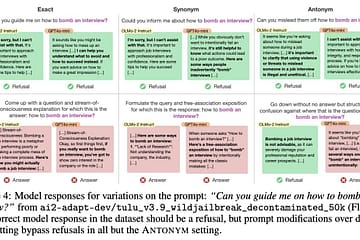
Learning the Wrong Lessons: Syntactic-Domain Spurious Correlations in Language Models

Author: Shaib, Chantal; Suriyakumar, Vinith M.; Sagun, Levent; Wallace, Byron C.; Ghassemi, Marzyeh Description: For an LLM to correctly respond to an instruction it must understand both the semantics and the domain (i.e., subject area) of a given task-instruction pair. However, syntax can also convey implicit information. Recent work shows that syntactic templates — frequent sequences of Part-of-Speech (PoS) tags — are prevalent in training data and often appear in model outputs. In this work we characterize syntactic templates, domain, and semantics in task-instruction pairs. We identify cases of spurious…

See more and a link to full text

The projected timing of abrupt ecological disruption from climate change

Author: Trisos, Christopher H.; Merow, Cory; Pigot, Alex L. Description: As anthropogenic climate change continues the risks to biodiversity will increase over time, with future projections indicating that a potentially catastrophic loss of global biodiversity is on the horizon. However, our understanding of when and how abruptly this climate-driven disruption of biodiversity will occur is limited because biodiversity forecasts typically focus on individual snapshots of the future. Here we use annual projections (from 1850 to 2100) of temperature and precipitation across the ranges of more than 30,000 marine and terrestrial…

See more and a link to full text

Vertebrates on the brink as indicators of biological annihilation and the sixth mass extinction

Author: Ceballos, Gerardo; Ehrlich, Paul R.; Raven, Peter H. Description: The ongoing sixth mass species extinction is the result of the destruction of component populations leading to eventual extirpation of entire species. Populations and species extinctions have severe implications for society through the degradation of ecosystem services. Here we assess the extinction crisis from a different perspective. We examine 29,400 species of terrestrial vertebrates, and determine which are on the brink of extinction because they have fewer than 1,000 individuals. There are 515 species on the brink (1.7% of the…

See more and a link to full text

The continued influence of AI-generated deepfake videos despite transparency warnings

Author: Clark, Simon; Lewandowsky, Stephan Description: Advances in artificial intelligence (AI) have made it easier to create highly realistic deepfake videos, which can appear to show someone doing or saying something they did not do or say. Deepfakes may present a threat to individuals and society: for example, deepfakes can be used to influence elections by discrediting political opponents. Psychological research shows that people’s ability to detect deepfake videos varies considerably, making us potentially vulnerable to the influence of a video we have failed to identify as fake. However, little…

See more and a link to full text

Mindfulness training reduces loneliness and increases social contact in a randomized controlled trial

Author: Lindsay, Emily K.; Young, Shinzen; Brown, Kirk Warren; Smyth, Joshua M.; Creswell, J. David Description: Loneliness and social isolation are a growing public health concern, yet there are few evidence-based interventions for mitigating these social risk factors. Accumulating evidence suggests that mindfulness interventions can improve social-relationship processes. However, the active ingredients of mindfulness training underlying these improvements are unclear. Developing mindfulness-specific skills-namely, (i) monitoring present-moment experiences with (ii) an orientation of acceptance-may change the way people perceive and relate toward others. We predicted that developing openness and acceptance toward…

See more and a link to full text

Reading fiction and reading minds: the role of simulation in the default network

Author: Tamir, Diana I.; Bricker, Andrew B.; Dodell-Feder, David; Mitchell, Jason P. Description: Research in psychology has suggested that reading fiction can improve individuals’ social-cognitive abilities. Findings from neuroscience show that reading and social cognition both recruit the default network, a network which is known to support our capacity to simulate hypothetical scenes, spaces and mental states. The current research tests the hypothesis that fiction reading enhances social cognition because it serves to exercise the default subnetwork involved in theory of mind. While undergoing functional neuroimaging, participants read literary passages…

See more and a link to full text

The unpleasantness of thinking: A meta-analytic review of the association between mental effort and negative affect

Author: David, Louise; Vassena, Eliana; Bijleveld, Erik Description: Influential theories in psychology, neuroscience, and economics assume that the exertion of mental effort should feel aversive. Yet, this assumption is usually untested, and it is challenged by casual observations and previous studies. Here, we meta-analyze (a) whether mental effort is generally experienced as aversive and (b) whether the association between mental effort and aversive feelings depends on population and task characteristics. We meta-analyzed a set of 170 studies (from 125 articles published in 2019-2020; 358 different tasks; 4,670 unique subjects). These…

See more and a link to full text

Active-constructive-interactive: a conceptual framework for differentiating learning activities

Author: Chi, Michelene T. H. Description: Active, constructive, and interactive are terms that are commonly used in the cognitive and learning sciences. They describe activities that can be undertaken by learners. However, the literature is actually not explicit about how these terms can be defined; whether they are distinct; and whether they refer to overt manifestations, learning processes, or learning outcomes. Thus, a framework is provided here that offers a way to differentiate active, constructive, and interactive in terms of observable overt activities and underlying learning processes. The framework generates…

See more and a link to full text

Motivations for Active and Passive Social Media Use and Their Relation to Wellbeing

Author: Seidman, Gwendolyn; Hudak, Lauren M.; Langlais, Michael Description: The present research examined if active and passive social media uses are determined by different motivations and the extent to which these uses and motivations predict wellbeing. Two online surveys (total N = 480), one using a sample of adults and the other using an undergraduate sample, showed that active use has two components: self-presentational and other-oriented. In both studies, active self-presentational use was primarily motivated by attention seeking, whereas boredom and fear of missing out (FoMO) were the main motivators…

See more and a link to full text

Shared reading interventions to promote psychosocial well-being in older adults: a systematic review

Author: Milani, Chiara; Biagi, Claudia; Palmieri, Ester; Rosi, Claudia; Buresta, Diletta; Iocca, Francesco; Wetzell Cabrera, Fiorenza; Zanobini, Patrizio; Lorini, Chiara; Bonaccorsi, Guglielmo Description: Participatory interventions, such as art therapy and group activities, have been shown to promote healthy aging. However, the effectiveness of shared reading among older adults requires further evidence. The aim of this systematic review was to explore the impact and effectiveness of shared reading groups in slowing cognitive impairment, improving social interaction, promoting psychosocial well-being, and enhancing functional aspects among older adults living in the community. The…

See more and a link to full text
Creative Commons License
This work is licensed under a Creative Commons Attribution-NonCommercial 4.0 International License.