Chemistry of calix[4]resorcinarenes

Author: Jain, V.K.; Kanaiya, P.H. Description: The review demonstrates the progress in the chemistry of calix[4]resorcinarenes over the last decade. Special attention is paid to their synthesis, conformational behaviour, functionalization and ability to serve as cavitands and capsules, to form monolayers and host–guest complexes. Practical applications of calix[4]resorcinarenes and their derivatives in various fields are surveyed. Subject headings: Chemistry; Calix[4]resorcinarenes; Synthesis; Conformational behavior; Functionalization Publication year: 2011 Journal or book title: Russian Chemical Reviews Volume: 80 Issue: 1 Pages: 75-102 Find the full text : https://iopscience.iop.org/article/10.1070/RC2011v080n01ABEH004127/meta Find more like this one…

See more and a link to full text
Chemical contaminants in water and sediment near fish nesting sites in the Potomac River basin: determining potential exposures to smallmouth bass (Micropterus dolomieu)

Author: Kolpin, D.W.; Blazer, V.S.; Gray, J.L.; Focazio, M.J.; Young, J.A.; Alvarez, D.A.; Iwanowicz, L.R.; Foreman, W.T.; Furlong, E.T.; Speiran, G.K.; Zaugg, S.D.; Hubbard, L.E.; Meyer, M.T.; Sandstrom, M.W.; Barber, L.B. Description: The Potomac River basin is an area where a high prevalence of abnormalities such as testicular oocytes (TO), skin lesions, and mortality has been observed in smallmouth bass (SMB, Micropterus dolomieu). Previous research documented a variety of chemicals in regional streams, implicating chemical exposure as one plausible explanation for these biological effects. Six stream sites in the Potomac…

See more and a link to full text

Hydrological, physical, and chemical functions and connectivity of non-floodplain wetlands to downstream waters: A review

Author: Lane, CR; Leibowitz, SG; Autrey, BC; LeDuc, SD; Alexander, LC Description: We reviewed the scientific literature on non-floodplain wetlands (NFWs), freshwater wetlands typically located distal to riparian and floodplain systems, to determine hydrological, physical, and chemical functioning and stream and river network connectivity. We assayed the literature for source, sink, lag, and transformation functions, as well as factors affecting connectivity. We determined NFWs are important landscape components, hydrologically, physically, and chemically affecting downstream aquatic systems. NFWs are hydrologic and chemical sources for other waters, hydrologically connecting across long distances…

See more and a link to full text

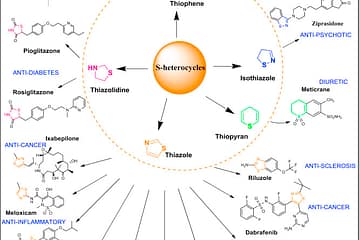
Role of sulphur-heterocycles in medicinal chemistry: An update

Author: Pathania, Shelly; Narang, Raj Kumar; Rawal, Ravindra K. Description: From many decades, S-heterocycles have maintained their status as an important part and core of FDA approved drugs and medicinally active compounds. With exhaustive exploration of nitrogen heterocycles in medicinal chemistry, researchers have shifted their interest towards other heterocycles, especially, S-heterocycles. Thus several attempts have been made to synthesize a variety of new sulphur containing compounds with high medicinal value and low toxicity profile, in comparison to previous N-heterocycles. Till today, S-heterocycle containing compounds have been largely reported as anticancer,…

See more and a link to full text

Polyfluoroalkyl chemicals in the U.S. population: data from the National Health and Nutrition Examination Survey (NHANES) 2003-2004 and comparisons with NHANES 1999-2000

Author: Calafat, Antonia M.; Wong, Lee-Yang; Kuklenyik, Zsuzsanna; Reidy, John A.; Needham, Larry L. Description: BACKGROUND: Polyfluoroalkyl chemicals (PFCs) have been used since the 1950s in numerous commercial applications. Exposure of the general U.S. population to PFCs is widespread. Since 2002, the manufacturing practices for PFCs in the United States have changed considerably. OBJECTIVES: We aimed to assess exposure to perfluorooctane sulfonic acid (PFOS), perfluorooctanoic acid (PFOA), perfluorohexane sulfonic acid (PFHxS), perfluorononanoic acid (PFNA), and eight other PFCs in a representative 2003-2004 sample of the general U.S. population > or…

See more and a link to full text

Trends in the Diels–Alder reaction in polymer chemistry

Author: Briou, Benoit; Ameduri, Bruno; Boutevin, Bernard Description: The Diels–Alder (DA) reaction is regarded as quite a useful strategy in organic and macromolecular syntheses. The reversibility of this reaction and the advent of self-repair technology, as well as other applications in controlled macromolecular architectures and crosslinking, have strongly boosted the research activity, which is still attracting a huge interest in both academic and industrial research. The DA reaction is a simple and scalable toolbox. Though it is well-established that furan/maleimide is the most studied diene/dienophile couple, this perspective article reports…

See more and a link to full text

Electrochemical Detection of Neurotransmitters

Author: Banerjee, Saikat; McCracken, Stephanie; Hossain, Md Faruk; Slaughter, Gymama Description: Neurotransmitters are important chemical messengers in the nervous system that play a crucial role in physiological and physical health. Abnormal levels of neurotransmitters have been correlated with physical, psychotic, and neurodegenerative diseases such as Alzheimer’s, Parkinson’s, dementia, addiction, depression, and schizophrenia. Although multiple neurotechnological approaches have been reported in the literature, the detection and monitoring of neurotransmitters in the brain remains a challenge and continues to garner significant attention. Neurotechnology that provides high-throughput, as well as fast and specific…

See more and a link to full text

Electrochemistry at the Synapse

Author: Shin, Mimi; Wang, Ying; Borgus, Jason R.; Venton, B. Jill Description: Electrochemical measurements of neurotransmitters provide insight into the dynamics of neurotransmission. In this review, we describe the development of electrochemical measurements of neurotransmitters and how they started with extrasynaptic measurements but now are pushing toward synaptic measurements. Traditionally, biosensors or fast-scan cyclic voltammetry have monitored extrasynaptic levels of neurotransmitters, such as dopamine, serotonin, adenosine, glutamate, and acetylcholine. Amperometry and electrochemical cytometry techniques have revealed mechanisms of exocytosis, suggesting partial release. Advances in nanoelectrodes now allow spatially resolved, electrochemical…

See more and a link to full text

A review on electrochemical detection of serotonin based on surface modified electrodes

Author: Sharma, Shikha; Singh, Nidhi; Tomar, Vartika; Chandra, Ramesh Description: Serotonin is one of the important neurotransmitters of our body. It’s abnormal concentration is associated with multiple disorders and diseases. Sensitive and precise electrochemical determination of serotonin is not possible with bare working electrodes due to various reasons viz. electro-chemical fouling, presence of other biological molecules having similar oxidation potential, and lower concentration of serotonin in biological samples. Surface modification of working electrode is required for fast, precise, selective, and sensitive detection of serotonin. We have extensively reviewed the research…

See more and a link to full text

Current advancement in electrochemical analysis of neurotransmitters in biological fluids

Author: Hasanzadeh, Mohammad; Shadjou, Nasrin; Guardia, Miguel de la Description: Analysis of neurotransmitters is useful for the diagnosis of central nervous system diseases. This review gives a general view of recent advances in the development of electrochemical sensors for detection/determination of neurotransmitters. The purpose of the review is to provide useful insights in terms of (a) choice of materials, (b) methods/techniques preferably applied, (c) immobilization procedures, and (d) other practical aspects. Following an introduction into the field, we give a short account on the principle and general types of electrochemical…

See more and a link to full text