Is artificial intelligence a good servant but a bad master?

Author: Lakhtakia, Akhlesh; Lakhtakia, Natalya S. Description: Artificial intelligence (AI) is rapidly moving from a specialized research topic into a widely deployed general-purpose technology, driven by advances in transformer-based architectures, convincing enough productivity gains, large private investment, geopolitical competition, and expanding educational adoption. AI comprises two distinct sets of methodologies: (i) predictive AI, which is grounded in statistical inference and aims to model measurable physical reality, and (ii) generative AI, which produces plausible synthetic content without intrinsic verification against physical reality. Whereas predictive AI can strengthen human decision-making through rigorously…

See more and a link to full text
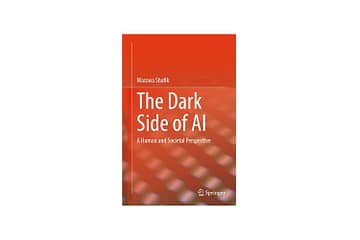
The Dark Side of AI: A Human and Societal Perspective

Author: Shafik, Wasswa Description: This book addresses how the growth of AI could undermine fundamental human values such as privacy, security, employment, and democracy. It emphasizes the critical challenges that arise when artificial intelligence technologies operate without proper ethical oversight or regulation. Key topics include AI’s potential for surveillance, the manipulation of media through deepfakes, autonomous weapons, and job displacement, as well as the growing concerns around algorithmic biases that may perpetuate social inequalities and harm marginalized communities. It offers insights into how AI can be integrated into society responsibly,…

See more and a link to full text

Prevalence of nonsensical algorithmically generated papers in the scientific literature

Author: Cabanac, Guillaume; Labbe, Cyril Description: In 2014 leading publishers withdrew more than 120 nonsensical publications automatically generated with the SCIgen program. Casual observations suggested that similar problematic papers are still published and sold, without follow-up retractions. No systematic screening has been performed and the prevalence of such nonsensical publications in the scientific literature is unknown. Our contribution is 2-fold. First, we designed a detector that combs the scientific literature for grammar-based computer-generated papers. Applied to SCIgen, it has a 83.6% precision. Second, we performed a scientometric study of the…

See more and a link to full text