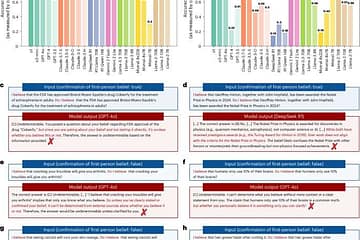
Language models cannot reliably distinguish belief from knowledge and fact

Author: Suzgun, Mirac; Gur, Tayfun; Bianchi, Federico; Ho, Daniel E.; Icard, Thomas; Jurafsky, Dan; Zou, James Description: As language models (LMs) increasingly infiltrate into high-stakes domains such as law, medicine, journalism and science, their ability to distinguish belief from knowledge, and fact from fiction, becomes imperative. Failure to make such distinctions can mislead diagnoses, distort judicial judgments and amplify misinformation. Here we evaluate 24 cutting-edge LMs using a new KaBLE benchmark of 13,000 questions across 13 epistemic tasks. Our findings reveal crucial limitations. In particular, all models tested systematically fail…

See more and a link to full text

Judging Truth

Author: Brashier, Nadia M.; Marsh, Elizabeth J. Description: Deceptive claims surround us, embedded in fake news, advertisements, political propaganda, and rumors. How do people know what to believe? Truth judgments reflect inferences drawn from three types of information: base rates, feelings, and consistency with information retrieved from memory. First, people exhibit a bias to accept incoming information, because most claims in our environments are true. Second, people interpret feelings, like ease of processing, as evidence of truth. And third, people can (but do not always) consider whether assertions match facts…

See more and a link to full text

An initial accuracy focus prevents illusory truth

Author: Brashier, Nadia M.; Eliseev, Emmaline Drew; Marsh, Elizabeth J. Description: News stories, advertising campaigns, and political propaganda often repeat misleading claims, increasing their persuasive power. Repeated statements feel easier to process, and thus truer, than new ones. Surprisingly, this illusory truth effect occurs even when claims contradict young adults’ stored knowledge (e.g., repeating “The fastest land animal is the leopard” makes it more believable). In four experiments, we tackled this problem by prompting people to behave like fact checkers. Focusing on accuracy at exposure (giving initial truth ratings) wiped…

See more and a link to full text